















/rating_1_off.png)
/rating_2_off.png)
Mulligans
Hunter
Hunter
Aggressive yet Dynamic Midrange Hunter
Summary
The midrange hunter decks that I’ve found all seem to provide a limited play style. Some are better than others, and when I found the one I liked the most, I started to customize it. I created a deck that closely resembles the one I liked the most, being infused with ideas taken from the other decks I had tried. I began to play and I realized that I was no longer dreading matches against Murloc paladins and Highlander hunters, as I could finally find some play style to counter their strategies.
Mulligans
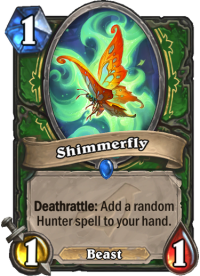
High Priority (Always keep)
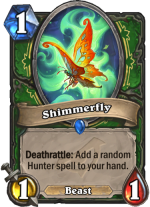
- Shimmerfly is an extremely useful card. When placed on round 1, you have a beast on the board that will give you a random hunter spell when it dies, and it has synergy with a lot of your other cards.
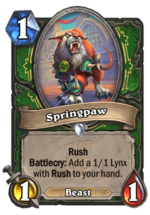
- Springpaw serves as a good starting option as well. It is best used when it can rush to destroy opponent minions and feed your Scavenging Hyena .
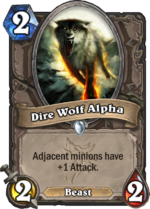
- Dire Wolf Alpha is in this deck to serve as a 2 mana drop that can provide great benefit without your opponent knowing. It has great synergy with Shimmerfly, Springpaw, AND Scavenging Hyena.
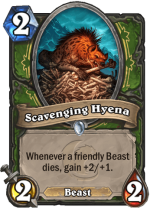
- Scavenging Hyena is important to mulligan when using this budget midrange deck as it can either snowball you towards your victory very early on in the game OR serve as a simple 2 drop that your opponent heavily focuses on, allowing you to disrupt aggro decks and wrestle power over control decks. If you find that you did not need to use it in the early game, you now have the ability to take advantage of it whenever you like.
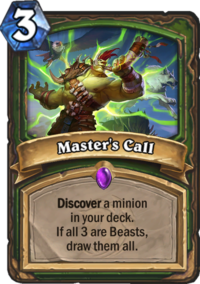
Low priority (keep under certain conditions)
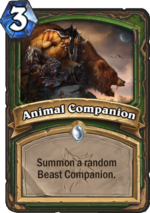
- Animal Companion is almost important enough to make it on the high priority list, but it doesn’t fit all play styles, and it should not be kept if you don’t have any lower cost minions. If you have 2 one or two drops in your hand already, definitely keep this card. If you have the coin, definitely keep this because you can secure the board with a great 3 drop on your second turn, or do some other great synergy with the help of the coin.
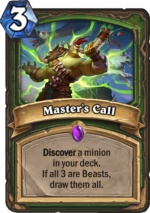
- Master's Call is better than Animal Companion for the deck’s play overall, but it is a more risky option in the beginning, as you want to secure control of the board as much as you can in the first three turns. But, if you already have both a 1 and 2 mana high priority card in your hand, you should keep the card if you think you’ll be able to handle not dropping a minion on your third turn. If you have the coin, DEFINITELY keep it as you’ll be able to use it a turn earlier, which makes a huge difference.
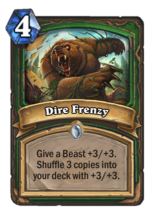
- Dire Frenzy is arguably the most important card in this deck. If you have a coin, and a 1 and 2 drop, keep this card.
Play Styles and Strategies
Overall
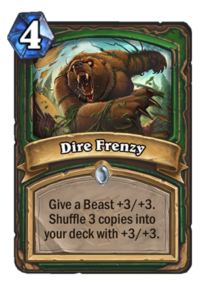
This deck revolves around its dynamic build to be able to face any challenge it is presented with. It is different from other midrange decks in that it focuses more on aggro. Start off the game by controlling the board as best you can, but try to find ways to attack the hero with your minions, even if that means not clearing your opponent’s board. You will lose some minions quickly this way, but you will gain minions just as quickly the next turn. Essentially, you’re trying to have the opponent focus on your minions, as you will have plenty of strong, low mana ones due to Dire Frenzy and Scarlet Webweaver. On top of that, they’ll be able to attack quick due to Tundra Rhino. As you keep doing this, you will eventually defeat the opponent.
What ensures this so well is Dire Frenzy, Master's Call, and Zul'jin. The first two already allow you to have 1 cost 4/4s with rush, for instance, that you can call to your hand with a single spell. Then, when you activate Zul'jin, needless to say, your hand will be nearly full with strong, low cost minions and spells, and you will most likely dominate the board. Additionally, you’ll have 5 armor and a hero power that allows you to strike 2 damage anywhere. It sounds quite unfair, and in a sense, it is. Most decks cannot keep up with this type of strategy.
First rounds
The opponent normally tries to get rid of Shimmerfly quickly, which they will consider a hassle. If they don’t get rid of it by your second turn, playing Scavenging Hyena can be a great move, ESPECIALLY if they’ve placed a weak, low cost minion on the board. After putting Scavenging Hyena on the board, you can attack the low cost minion with your Shimmerfly, giving you a free Hunter spell, a +2/+1 on your Scavenging Hyena, and possibly clearing your opponent’s side of the board, if not heavily weakening it. If you sense that your Scavenging Hyena would just be taken out the next turn, however, then consider other options, and only resort to the Scavenging Hyena as a somewhat desperate control move (which is necessary, at times). If your opponent doesn’t get rid of your Shimmerfly by turn 4, this shows you that they are inexperienced, unfocused, and/or uncaring, as if you have a Dire Frenzy in your hand, casting this on your Shimmerfly can easily guarantee you the game. Casting Dire Frenzy on your Springpaw or its Lynx can also be extremely helpful.
Situational
- Scavenging Hyena works well with Springpaw, Desert Spear, Unleash the Hounds, and Shimmerfly. At times, it is good to play Unleash the Hounds for no other reason than to buff up your Scavenging Hyena.
- Tracking should only be used when absolutely advantageous.
- Hunter's Pack should only be used as a last resort or when nothing else is necessary to play.
- Kill Command should be used interchangeably between minions and the enemy hero.
- Baited Arrow works very well when Tundra Rhino is on the board, and should only be used when Overkill is possible or as a last resort.
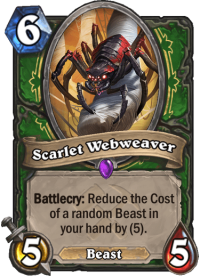
- Scarlet Webweaver should be played when the only minions in your hand are Tundra Rhino or Savannah Highmane. Additionally, keep in mind that if you play it and you have 6 mana total, only a Tundra Rhino will become a 0 cost card. If the Savannah Highmane is triggered instead, you will have to wait another turn to play it.
- Zul'jin should be played in accordance to what cards you have in your hand and what spells you have casted throughout the game. This card is best to play when both you and your opponent have very few minions on the board. Optimally, your opponent would have at least one more minion than you, however. When you play it, you will most likely gain a few minions on the board and in your hand.
