















/rating_1_half.png)
/rating_2_off.png)
Mulligans
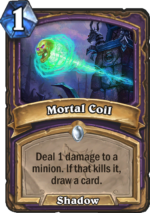
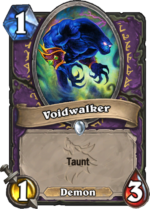
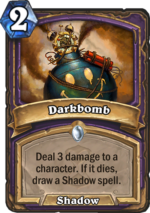

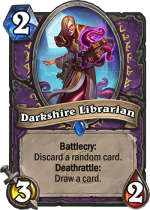
General Mulligans
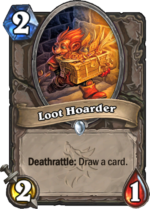
In general, look for Warlock earlygame and Loot hoarder. The better you contest the board in the earlygame, the more likely you are to push your advantage further ahead when Renounce Darkness is drawn.
Aggro Mulligans
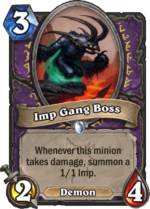
You really need to contest the earlygame to have a good chance at defeating aggro. These cards in combination with Implosion, Belcher, Argus, and Imp Gang Boss off the draw make it difficult for aggro to do much against your board while also pushing face damage. This deck has very little in the way of dealing with direct damage so be sure to play fast and mulligan for these cards aggressively to avoid getting in range of those spells in the first place.
Midrange Mulligans
Mulligan for cards that contest the board early to constantly hold board advantage. Your neutral minions help out a ton here. Play Renounce Darkness when you have board control to refuel after fighting for the board.
Combo Mulligans
You have very little chance of winning against combo decks. Push for as much damage as possible.
Tech Loatheb, Kezan (where Applicable), Flame Imp, and Power Overwhelming to have a better chance against combo decks, but if you see a lot of them in the first place, this probably isn't a good deck to play in the meta.
Control Mulligans
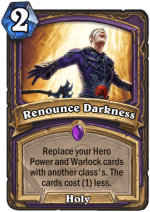
Your main goal against control is to draw Renounce Darkness as early as possible and present mana-reduced threats to your opponent. Life Tap as much as reasonably possible to maintain a large hand size before playing Renounce, increasing the chance of an on-curve play.
This deck aims to always have an early game play against any deck, switching its gameplan around with Renounce Darkness to fight against other control and midrange decks with the help of card discounts. Almost every class except for Hunter has a good chance to give you good lategame tools at random.
Gameplan:
Draw into Renounce Darkness as quickly as possible against control, slowly crush your opponent with card discounts.
Against aggro, don’t play Renounce Darkness early and continue playing with your earlygame removal and minions, curving out into your neutral cards.
Combo should be a tough matchup since your cards generally lack synergy after you play Renounce Darkness, but get dealt with too easily otherwise; try to rush down your opponent as quickly as possible. Freeze Mage specifically is almost impossible to beat.
Card explanations:
Most card either fit the “Warlock Earlygame and Early Control”, “Solid Midrange Minion”, or “Efficient Card Draw” category. Those that do more than one of these are even better.
The one card that doesn’t seem to fit into these is Defender of Argus . Argus is meant to function as a glue of sorts for the random cards you receive and as stall and assistance for your earlygame Warlock cards should Renounce Darkness not be in your first 15 cards. If you receive discounted minions that have next to no synergy with anything else, they could at the very least function as taunt walls to protect your hero. For a similar reason, Sunfury Protector (also taunts) and Violet Teacher (makes useless spells into 1/1 minions) can be considerations for the deck as well.
Old God cards:
Darkshire Librarian is a very interesting card since it cycles deeper into your deck on a strong body. In this deck, the only really important card we have to draw is Renounce Darkness, which we would play before the Librarian in most cases. Most of the cards discarded shouldn’t be particularly important to your gameplan, so the card seems to fit right in.
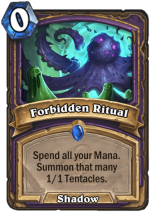
Forbidden Ritual is a very solid card to contest the board against aggro. Furthermore, it scales up to 7 mana where it can present a challenge for control. As a curve filler card it’s also useful for keeping Midrange decks at bay. While your opponent may have AoE, they might use it after you play Implosion, making the board a difficult one to deal with.
Why play this deck?
Adaptability:
Your deck changes in response to that of your opponent. You can use every Warlock card to combat aggro and have a deck based on beating aggro and have a positive winrate against aggro. That’s nice and all, but since all your tools are anti-aggro or earlygame board control, you tend to lose to greedier decks; but now you have Renounce Darkness which flips all those anti-aggro tools to random ones which are probably a lot better than your current anti-aggro cards in a control matchup.
It’s a very similar effect to Elise Starseeker; despite the fact that all the legendaries in your deck are random, they are on average better than the anti-aggro tools you have left in your deck against other control decks. Elise is very slow though, with the requirement of playing 3 separate cards for her effect. As a result, all she does is help control decks beat other control decks in the lategame.
Renounce Darkness is different, you can change your deck a lot faster so it fits a midrange deck better. It also lets you keep your neutral cards so you can adjust the potency of the effect in the deckbuilding stage and still have good neutral tech options for the meta (with Golden Monkey those would evaporate). A good analogy for this would be that you are playing a 30 card deck with a 12-18 random card sideboard that you can swap in during a game.
Discounts:
The class cards you receive are random and lack significant synergy. However everything costs one less, which means that even the worst of cards aren’t all that bad. 2 average quality cards negate your tempo loss from playing Renounce Darkness, any more and the card has given you free ramp. If you use the right neutral “glue” to make use of those cards the randomness matters little since your opponent would find it hard to catch up to you saving mana each turn. You face the slight problem of running out of cards in that case since you don’t have Life Tap, but good neutral draw can fix that. It’s a deck that builds itself when you ask “What if?” enough times.
The Hero Power change is neither here nor there, but if you get to a low health total or to the bottom of your deck, which is a possibility after playing Renounce Darkness, anything is better than Life Tap.

In order to increase the possibility for synergy with cards you draw, you can see my analysis of synergies by class on reddit:
https://www.reddit.com/r/hearthstone/comments/4g71j3/renounce_darkness_analysis_standard/
Quite a nice list, it’s very useful to know what synergies to look out for when playing Renounce Darkness. In fact, these very synergies show how useful it is to build a deck core out of Neutral minions that satisfy these roles and can be played on curve otherwise.
Some of these requirements are satisfied by a few neutral cards in this deck:
– Shredder is a Mech
– Loot Hoarder, Belcher, Shredder, Sylvanas, and Dr. Boom are Deathrattle
– Azure Drake is a dragon, but also provides battlecry and spellpower.
Others aren’t satisfied because including these cards weakens your deck quality overall:
– Murloc
– Pirate
– C’Thun cards in a non-C’Thun deck (though C’Thun’s Disciple may be an exception)
The solution to this is likely placing more draw into your deck; this allows you to ignore dead draws such as Anyfin Can Happen (which you probably shouldn’t be playing anyway) and draw into other cards that can enable that synergy (Beast for Hunter, Self-Damage for Warrior).
I’ll definitely say though, with there being so many Beast requirements in the Hunter class, it might be worth playing a few solid Neutral Beasts such as Stranglethorn Tiger or Haunted Creeper for the effect.
One other thing, this deck is meant to be played in the Wild format so there would probably be different synergies to emphasize, particularly Mech or Deathrattle.